
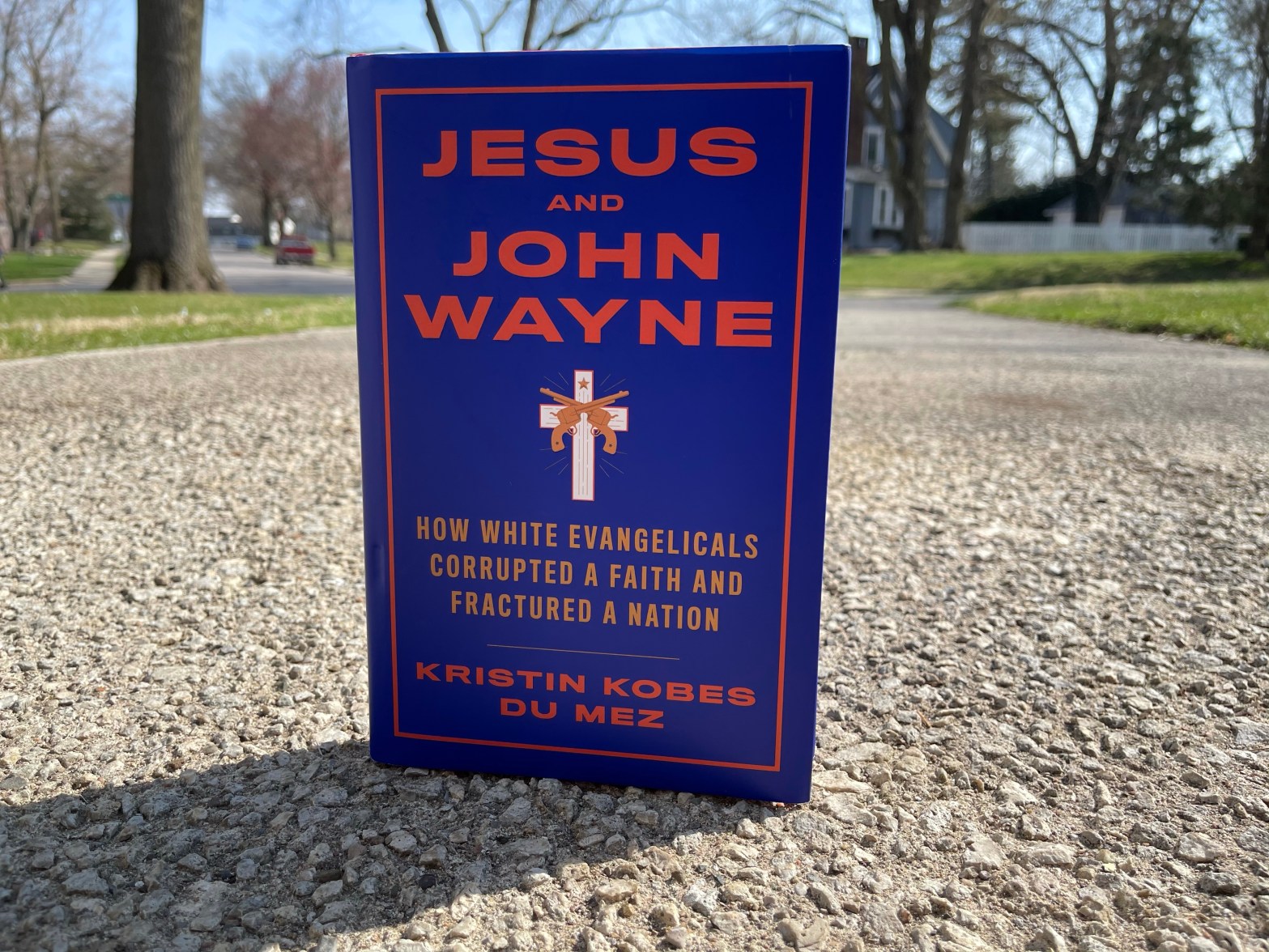
Pictured: Jesus and John Wayne: How White Evangelicals Corrupted a Faith and Fractured a Nation by Kristin Kobes Du Mez. You can buy the book here.
Have you ever had a moment where you learn some new piece of information and it totally changes your thought patterns? It doesn’t just change how you move on from that moment in time, it also changes your perception of the past. I recently had one of these moments after reading Jesus and John Wayne: How White Evangelicals Corrupted a Faith and Fractured a Nation by Kristin Kobes Du Mez. In her book, Du Mez chronicles not only the rise of the Moral Majority and the Religious Right but also the rise of militant masculinity in white evangelicalism over the past seventy years.
In Jesus and John Wayne, Kristin Du Mez writes about the men and women who created and helped foster this atmosphere of militant masculinity. From Jerry Falwell, Pat Robertson, and Tim and Beverly LaHaye to James Dobson, Mark Driscoll, and Eric Metaxas these men and women helped shape a generation of evangelical thought defined by racism, bigotry, sexism, homophobia, xenophobia, and Islamaphobia. If you are looking for an example of the thought patterns and ideologies that led 81% of white evangelicals to vote for Donald Trump in 2016 and another 75% in 2020, look no further than the men and women listed in this book.
For me, this book was extremely personal in a way I didn’t think was possible. From everything I had read on Twitter surrounding the book, I knew that it would be a hard, disturbing read for people, like me, who have been heavily involved in white evangelical culture. And, I was correct in my assumption. Each new chapter challenged me and caused me to look differently at popular figures in the white evangelical world than I had previously. As Du Mez traveled through the past seventy years of white evangelical history, I caught myself recognizing name after name. People and organizations that I am familiar with kept popping up in unexpected and horrible ways. As I read, I became filled with a sense of dread: what new evangelical leader or organization would show up next?
I’ve grown up deep in the white evangelical church. I’ve gone to church for as long as I can remember. Most of the people I know are white evangelicals. I’ve consumed significant amounts of media from Focus on the Family, the organization founded by James Dobson. I’ve listened to Jonathan Park, an audio show previously put on by Vision Forum an organization founded by Doug Philips and devoted to promoting the “biblical patriarchy” in the homeschool community. I’ve read a Dobson book and consumed many other forms of conservative Christian media from books and audio programs to movies and TV shows. I have attended churches with people deeply involved in purity culture and legalism. And, although my parents never ascribed to either, I know many who did.
As I read through Jesus and John Wayne, I began to realize the influence white evangelical culture and media had on me both consciously and subconsciously. And, as the layers were peeled back on issues like gender roles, LGBTQ+ rights, abortion, racial justice, immigrants, and Muslims I began to see how these issues had not only overtaken the Gospel, but become weaponized over the years to stoke fears and seize power. I thought back to discussions about Barack Obama’s birth certificate and other thinly-veiled conspiracy theories surrounding Muslims. I thought back to the strong outpourings of anger any mention of LGBTQ+ rights would elicit out of evangelicals. I remembered the ways abortion has been weaponized for political gain and used to shut down any dissent. I also recalled the ways women—including women I know—have been treated in churches. Women who were told that their place was “with the children” or among other women and not in the pulpit because God “doesn’t approve of women holding authority over men.”
As I read this book, the doubts I had about white evangelicalism began to grow. This wasn’t the first time I had experienced these feelings of doubt. About three years ago, my perceptions on faith and politics began to change. Having grown up in white evangelicalism and the culture molded around it, I naturally adopted the worldview and opinions of those who surrounded me. This involved taking on worldview and opinions that now, looking back, I am shocked that I ever ascribed to. One of my most vivid memories from this time in my life is from November 4, 2016. I’ll never forget the feeling of joy I had that morning when I woke up and saw that the presidential race had been called for Donald Trump. Our man had won. Hillary Clinton and her “radical” campaign had been defeated. We would now be safe from the government infringing on religious liberty. We had someone who would appoint conservative Supreme Court Justices and, as a result, hopefully, end abortion. All was well.
Except, all wasn’t well. My fifteen-year-old self had missed what 81% of white evangelicals had missed: Trump’s message was contrary to the gospel and he had no business representing American Christians or supposedly “championing” our faith or values. It wasn’t until over a year after the election that I began to think seriously about Trump and what he represented. I began having conversations with friends who were also beginning to question their stance on Trump and key political and social issues. We read about Trump and the things that he had said and done before and after he was in office. We shared stories about family and friends who defended Trump no matter what hateful or racist things sprung from his mouth. We discussed the things Trump stood for and came to the realization that these things were contrary to what we believed and we could no longer align ourselves with him or that brand of conservative Christianity that supported him no matter what.
After realizing these things, I was also beginning to discover that there were many other aspects of conservative Christian culture that I did not agree with. I didn’t agree with the horrible treatment of LGBTQ+ people, people made in the image of God and loved by him, and the hate that many Christians have toward them. And, as I read the numerous accounts of sexual abuse that have plagued white evangelical churches, the purity culture I’ve witnessed went from misguided in my mind to despicable. I didn’t agree with the way Christians were able to write off climate change as “ridiculous” or “something I don’t need to worry about.” And I didn’t agree with the caviler way immigrants and refugees were written off as “illegals who want to take our jobs and our country.”
Over the past couple of years, I’ve stepped further and further away from white evangelical culture. I became disillusioned by a group that claimed to be “pro-life” and yet were unwilling to wear a mask to a grocery store to protect their neighbors. I grew tired of pleas for racial justice being met with indifference or all-out opposition by white evangelicals. I was angry that the Black Lives Matter movement was simply labeled as “Marxist” or “communist” and dismissed because “we can’t support the Black Lives Matter organization” while systemic racism was either being completely ignored or treated as if it doesn’t exist. I was disheartened by white evangelicals who, after four years of Trump, took up his mantle again—with force— “for the sake of abortion” while seeming to care little for lives outside the womb or understanding what he stood for.
This past year, I’ve had serious discussions with white evangelical friends who believe that “systemic racism doesn’t exist,” claim that according to the Bible you can’t say “Black Lives Matter,” and say that people who resist arrest, like Rayshard Brooks, “are probably going to get shot.” Throughout these discussions, I’ve seen how truly ingrained white supremacy and racism are in many churches and individuals. In addition to this, as I have become more public in my views on Trump over the last year, many in my family have talked about me behind my back and insulted me. I have been called manipulative, my writing and thinking have been ridiculed, and I have been treated not as a person who is loved no matter what, but as someone who must be corrected and converted back to conservatism at all costs—no matter if it hurts. These family members are all Christians. We both follow the same savior who said that one of the greatest commandments is “to love your neighbor as yourself.”
As I’ve had these conversations, grieved these losses of closeness and love from my family, and seen some of the worst of white evangelicalism, I’ve had to reevaluate my faith. I’ve seen that white supremacy, Trumpism, and Christian nationalism have invaded large portions of white evangelicalism and I have spent considerable time trying to reconcile my faith with the words and actions of evangelicals who have been emboldened by Trump and his rhetoric over the last four years. I have seen and experienced some of the worst of American evangelicalism and it almost broke me.
But, at the same time, I’ve also seen some of the best of American evangelicalism. I know many Christians who have devoted their lives to the service of others, who love unconditionally and seek to show the true love of Christ. They also aren’t afraid to speak out on important issues and challenge established norms and power structures. I see people like Kristin Du Mez, Jemar Tisby, Phil Vischer, David French, and Justin Giboney fighting desperately for change in the American Church, grappling with the past, and striving for a better path forward and it gives me hope that things can be better one day.
These thoughts—and the background history from Jesus and John Wayne—have left me with a question: Where do we go from here? There has been a growing movement of ex-evangelicals (“exvangelicals” as they are often called) rising out of white evangelical churches. These exvangelicals, no longer able to reconcile their faith with the American church, are either leaving their churches or leaving the faith tradition altogether. In addition to this movement, there has also been an exodus of Black Christians from white evangelical spaces since 2016. Jemar Tisby, author of The Color of Compromise: The Truth about the American Church’s Complicity in Racism, has been leading a movement entitled #LeaveLOUD as a response to the quiet exodus of Black Christians from white evangelical churches. Through the #LeaveLOUD movement, Tisby encourages Black Christians to make it known why they are leaving white evangelical spaces (racism, Trumpism, Christian Nationalism, not feeling valued or appreciated as part of the community) instead of quietly exiting.
The topics of #LeaveLOUD and the exvangelical movement were recently addressed in an article by Kristen Du Mez in The Anxious Bench entitled “#LeaveLOUD and the Evangelical Reckoning.” I wanted to quote the end of the second to last paragraph and the last paragraph which fit perfectly with what I have been discussing:
“When it comes to institutions, however, I continue to see the active protection of existing power structures, persisting silence, and far too little courage exhibited in the face of those entrenched powers.
#LeavingLOUD plays a vital role in revealing dynamics that often remain hidden—dynamics that must be brought into the light. Depending on the circumstances, #StayingLOUD can do the same thing. But silence in leaving or remaining will only allow these patterns to persist. It is long past time for white evangelicals to call out injustice, bigotry, violent rhetoric, disparaging language, racism, misogyny, abuse of power, and the idolatry of Christian nationalism in their own communities, even if doing so comes at a cost. The cost of not doing so is undeniable, and it is a cost largely born by others.”
As seen in Jesus and John Wayne, white evangelical power structures are strong. They have been built up over many years and it will take speaking out against them to create true, lasting change. But, staying silent on key issues in churches will only perpetuate problems and, as Du Mez says, the cost of that will largely be born by others.
I’ve talked a lot in these last couple of paragraphs about the “us” but I haven’t focused on where all of this leaves me. To be honest, I don’t exactly know where to go from here. I still love Jesus. I still believe in the hope of the Gospel and the truth of the Bible. I seek to carry out the true mission of the church, not the culture wars mission that seeks to keep prayer in schools or keep God on our money. But, at the same time, I am weary. I don’t know if I can continue in these places or environments where new thoughts or ideas are treated as a threat, racial justice and other important issues are all out ignored or replaced with the “but abortion” narrative, and where the people of Christ don’t show his love or care for others—even in their own family. I can’t in good conscience stand by while racism, misogyny, xenophobia, and Christian nationalism are allowed to persist. I am not the same person I was in 2016 and I never will be. That chapter of the toxic influence of white evangelical culture on my life is over—for good.
But, I don’t think I can leave—at least not yet. Amid all this toxic ideology, I still find hope. As I look at my friends and others in my generation, I see a generation of people who see through insincerity and dangerous power structures in the church. They care deeply about people and desire to protect life in all its forms. They seek to make the church a place where everyone is welcomed, valued, and loved—not for their possibility of conversion—but for the whole person that they are. I see hope in them. And because of that hope, I believe there is still something in the American church worth fighting for and that there is a better path forward. I don’t exactly know what that path looks like or what the future holds, but, in this moment, I remain here, speaking out and attempting to forge a new legacy. The church doesn’t have to be this way. White evangelicalism doesn’t have to be this way. It’s as Kristin Du Mez says in the conclusion of Jesus and John Wayne: “What was once done might also be undone.” But only if we #LeaveLOUD or #StayLOUD.
 Zebadiah Demorest