
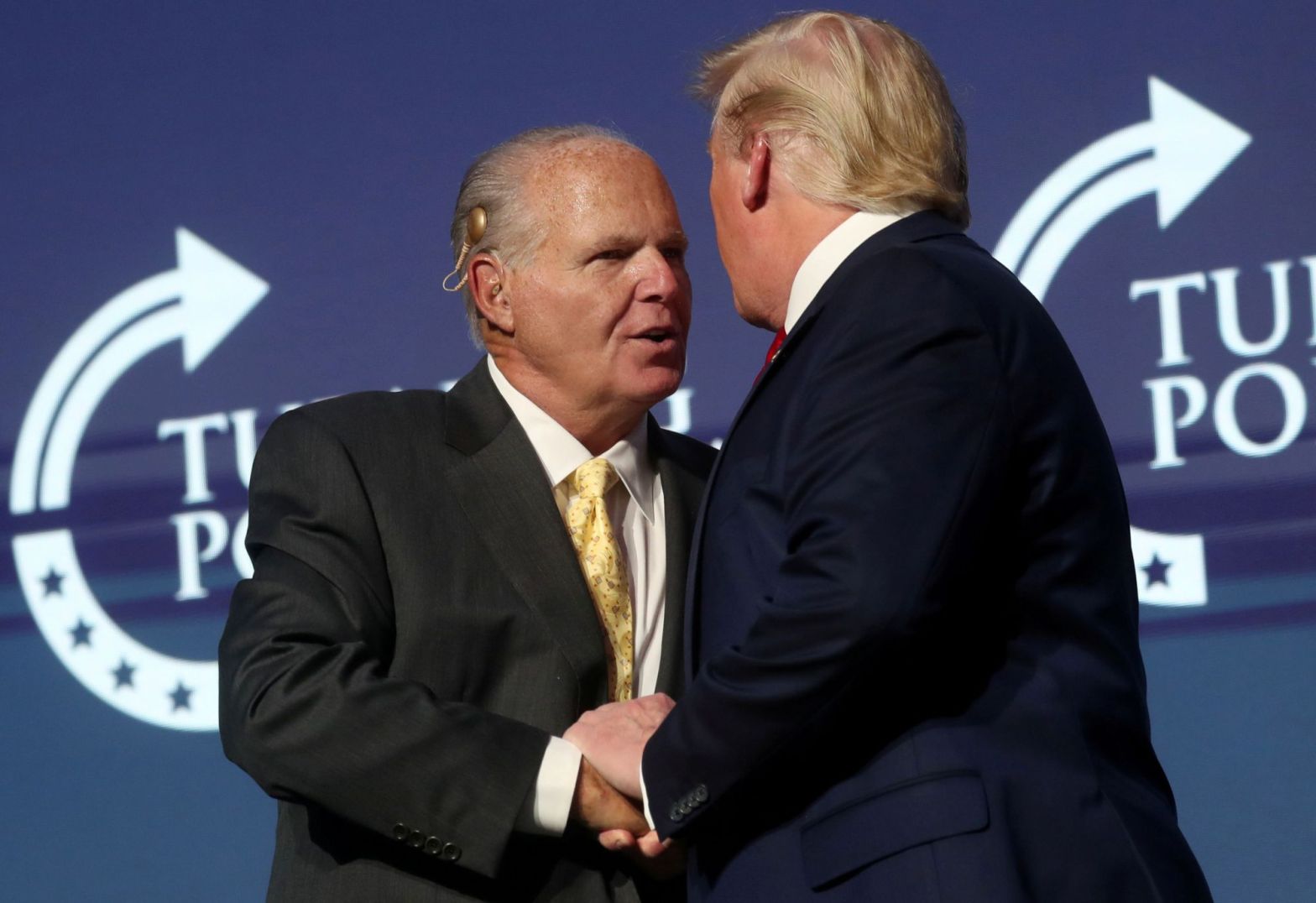
Former U.S. President Donald Trump greets Rush Limbaugh before delivering remarks at the Turning Point USA Student Action Summit at the Palm Beach County Convention Center in West Palm Beach, Florida, U.S. December 21, 2019. REUTERS/Leah Millis/File Photo
As someone who grew up surrounded by many conservatives I was familiar with Rush Limbaugh from a young age. Many people in my family listened to him (whether frequently or infrequently) and many other people I know were casual listeners. I’ve heard some of his program on and off over the years. When I was younger, I remember thinking that his program was a little odd—but in a funny way. Here was this guy on the radio yelling about random people, going on long rants, and making odd references to “feminazis” and something called “the Rock Hudson disease.” I didn’t really understand him, but most of the people I knew seemed to enjoy him.
Years down the road, as my views started to change and I learned more about Rush, I realized the truth about him. I’ve read about his radio segment called “AIDS Update” where he mocked people who had died from AIDS, playing music as he read their names over the air. Limbaugh ended the segment after two weeks and referred to it as “the single most regretful thing I’ve ever done.” I read about his open misogyny when he labeled Sandra Fluke, a Georgetown law student who testified in congressional hearings in support of an Obama administration policy that required health insurance plans to cover contraceptives for women, a “slut.” He later apologized for the “insulting word choices.” I read about his quote from 2004 on the NBA: “I think it’s time to get rid of this whole National Basketball Association. Call it the TBA, the Thug Basketball Association, and stop calling them teams. Call ‘em gangs.” More recently, I’ve seen Limbaugh compare COVID-19 to the “common flu” claiming that it was “being weaponized as yet another element to bring down Donald Trump” and float the baseless conspiracy theory that the 2020 U.S. Presidential Election was “stolen” from Donald Trump.
Limbaugh built his career on fear and divisiveness. He consistently demonized those on “the other side” and, even worse, gave his millions of listeners permission to fear and hate their enemies—at least those they perceived to be their enemies. I’ll never forget the call-ins I heard from listeners eager to have Rush affirm their views or conspiracy theories about the “evil democrats.” They looked to their champion, the embodiment of the “Make America Great Again” ideology before Trump was even a thought for president, for his stamp of approval.
My purpose with this article is not to chronicle every racist, misogynistic, or homophobic thing that Limbaugh said. Instead, I write these so we can truly get an accurate picture of who Limbaugh was and what he stood for. Since his death, I have seen people, many of them Christians, praising Limbaugh as a “great man and patriot.” This glamorizes him as a champion of conservatism, but it fails to capture his true being. The reality is that Limbaugh was a man who spent his career dividing people and spreading hate and giving his listeners license to do the same. Limbaugh may have done great things for veterans and military members, but that does not make up for the damage done by his words and actions.
But, on the other hand, I have seen something just as disturbing as the things Limbaugh said: the reaction to his death. When the news of his death first broke, many were openly cheering and celebrating. I get it. When someone hurts us, whether with words or actions, we want to lash out against them and make them truly suffer. To revel in their pain. To see them and those they love suffer as much as we have. It’s a part of our human nature. But in the process of this, we lose our humanity. We forget that Limbaugh was just another man like us. He had a family. He had a life beyond his radio career. We also forget that he didn’t spew his hate into a void; millions of people listened to him and supported him. He may have helped push them over the edge, but at the end of the day, they chose to listen to him. They are as much a part of the problem as he was.
I understand the hurt and frustration. I’ve seen many members of my family fall victim to the conservative media machine headed by Limbaugh. I also know that as a straight white man from Indiana, I can never truly understand the hurt he caused people of color, women, and members of the LGBTQ+ community. But, in looking at the replies and reactions to his death, I was deeply unsettled and horrified. Many of these people who mocked his death are the same people who fight for human rights and racial justice and advocate for the poor and marginalized. If we can care about other humans and affirm their human dignity, we must affirm the human dignity of everyone—including people who have hurt others and maybe even us. That doesn’t mean that we need to forget what he said or the harm he caused, but it means that we need to do what Limbaugh would never do: show grace and compassion to our enemies. It doesn’t mean that we can’t be relieved that his negative influence over millions of Americans has gone with him, but we shouldn’t actively wish death on anyone or even rejoice in their suffering or death.
Let us work to dismantle Limbaugh’s legacy. Let us work to overcome the hate that he nourished and to reach out to those who don’t think like we do or believe the same things we do. To borrow an extremely overused but great Martin Luther King Jr. quote: “Darkness cannot drive out darkness; only light can do that. Hate cannot drive out hate; only love can do that.” Let us drive out the darkness and hate with light and love. Don’t let yourself fall into the same trap of hate that Limbaugh and millions of others have fallen into. Because from the times I have listened to Limbaugh, I know that he wouldn’t have looked at the response to his death in anger or sadness. Instead, he would have looked at the responses with joy because he would know that he and his brand of hate had won in the end. And he would be right.
 Zebadiah Demorest